jueves, 14 de abril de 2022
Museo Mural Diego Rivera
Dentro de este contexto , la Coleccion de Arte Cantú Y de Teresa y El Museo casa Estudio Federico & Elsa presentan cuatro obras icónicas de la Escuela Mexicana de Escultura y talla directa que forman parte de dichos acervos
Ejemplo de ello es la maqueta en bronce de lo que alguna vez fuera el Monumento a la Madre de Luis Ortiz Monasterio y que desapareciera parcialmente a partir del temblor del 2017 , tambien y enriqueciendo esta visión de la mexicanidad se encuentra la firma monograma “ autorretrato como
escultor de Federico Cantú; escultura en bronce que muestra la firma del mural “enseñanzas de Quetzalcóatl” IMSS Centro Medico, mural que tambien sufriera daños en el temblor de 1995 , de ahí a que la importancia de dichas obras son el testimonio de una época de la monumentalidad en Mexico y sin duda Narran la maestria de estos dos coloso del arte nacional.
Adolfo Cantú
jueves, 24 de marzo de 2022
The National Museum of Mexican Art – Chicago
Surrounding Kahlo:
Works from the Permanent Collettion
March 5, 2022 – January 15 , 2023
Rubin & Paula Torres Gallery
Dear Adolfo:
How are you?
I'm very pleased to include the following artwork you donated, in an exhibition I curated titled Surrounding Kahlo: Works from the Permanent Collection.
Luz Fabila Montes de Oca (b. 1905 Amanalco de Becerra, Estado de México - d. 1984 Mexico City), Retrato con rebozo y chalina (autorretrato) / Portrait with Headscarf and Shoulder Wrap (self-portrait), 1941, oil on paper / óleo sobre papel, National Museum of Mexican Art Permanent Collection, 2015.116, Gift of Adolfo Cantú on behalf of CYDT Colección de Arte Cantú y de Teresa in memory of Federico Cantú and Luz Fabila Montes de Oca
For more information, please visit:
https://nationalmuseumofmexicanart.org/events/surrounding-kahlo-works-from-the-permanent-collection
The official reception will be on Friday, April 1, 2022 from 6:00 - 8:00PM. Please check the NMMA newly designed website (www.nationalmuseumofmexicanart.org) as we get closer to April 1st as details regarding the reception are evolving.
I hope if your travel plans include Chicago, you'll consider a visit to NMMA as this exhibition has a very long run.
Sincerely,
Rebecca D. Meyers
Permanent Collection Curator
The National Museum of Mexican Art is thrilled to announce the opening of Frida Kahlo, Her Photos. The exhibition comes from the archive of photographs that belonged to her personally and which were largely unknown. Now grouped together thematically into six sections by renowned Mexican photographer, curator and historian of photography in Mexico, Pablo Ortiz Monasterio, the exhibition reveals parts of the personal history of an artist, of a country and of a period. It is a photographic collage made up of images that allow us to discover new facets of a key figure in the 20th century.
The National Museum of Mexican Art – Chicago
Surrounding Kahlo:
Works from the Permanent Collettion
March 5, 2022 – January 15 , 2023
Rubin & Paula Torres Gallery
(Detail) Ester Hernández (b. 1944), If This Is Death, I Like It (Si esto es la muerte, me gusta), 1991, serigraph / serigrafía, 11/70, NMMA Permanent Collection, 1993.14. Photo credit: Kathleen Culbert-Aguilar
Undoubtedly, the visage of Frida Kahlo has become the most instantly recognizable of all artists across time. Since her popularization in the 1980’s, she has been the subject of books, movies, an opera and a great deal of visual art created by others who have been moved by her paintings and life story. Drawn entirely from the Museum’s Permanent Collection, this exhibit explores works inspired by Frida Kahlo; the work of her students, known as “Los Fridos,” who learned from and surrounded her while she recovered at home in La Casa Azul; as well as familiar items that Kahlo chose to surround herself with such as arte popular, Mesoamerican artifacts and traditional clothing from her beloved Mexico.
Curated by Rebecca D. Meyers
Sin duda, el rostro de Frida Kahlo se ha convertido en el más reconocible al instante de todos los artistas a través del tiempo. Desde que su imagen se popularizó en los años ochentas, Frida ha sido el tema de libros, películas, una ópera y una gran cantidad de arte visual creado por otros artistas que han sido conmovidos por sus pinturas y su vida. Extraída enteramente de la Colección Permanente del museo, esta exposición explora obras inspiradas por Frida Kahlo; las obras de sus estudiantes conocidos como “Los Fridos”, quienes aprendieron y convivieron con ella mientras se recuperaba en su hogar “La casa azul”; así como con objetos familiares con los que Frida se rodeaba, tal como arte popular, utensilios mesoamericanos y el vestuario tradicional de su México querido.
Curado por Rebecca D. Meyers
Sponsors
BMO Harris
The Chicago Park District
The Joyce Foundation
Prince Charitable Trusts
Illinois Arts Council Agency
Hace una década Lupe Rivera me invito a firmar un acuerdo de colaboración con el Museo de Chicago , fue la época en la que el Museo presentaba una exposición y catalogo de mujeres en la pintura Mexicana , Carlos Tortolero fundador del Museo y Director del mismo nos invito a Expo Chicago y de ahí todo es historia ……..
El NMMA es un recinto que dedica de manera exponencial la presencia de el Arte Mexicano y de paso permite que nuestros conciudadanos que radican en los estados Unidos tengan un acercamiento a nuestra cultura y tradición , de ahí a que esta exposición sumara una nueva y fructífera imagen de nuestro país
En hora buena
Bo
sábado, 29 de enero de 2022
The Dorian Sketchbook of Federico Cantú: Scenes from his Private Life
Part I: “Dorian”
1928
After living in Paris since 1924, Federico Cantú Garza – at that time a young painter who used the pseudonym "Dorian"- decides to visit Mexico for a short break in the spring of 1928.
After the usual sea voyage, in third class and stopping in Cuba, he finally arrived in Veracruz in May 1928, proceeding by land from the port to Mexico City and arriving exhausted at his house in Calle de San Francisco, Colonia del Valle. In his baggage, made up mainly of clothing, art supplies, books, tools and even a couple of revolvers, the young master treasured Joyce’s Ulysses, Goethe’s Faust, and the well-known work of Oscar Wilde from which he took his artistic name.
His mother, the writer María Luisa Garza, "Loreley", who had been writing a series of novels for an entire decade, was pleased by the set of books that her favorite son decided to bring her in appreciation of her unstinting economic support which had allowed him to pay for his stay in Paris.
Federico could not have imagined that he was arriving at precisely the moment that his mother’s life was about to turn completely around, leading her to leave Mexico. She intended to restart publication of her magazine entitled “Alma Femenina", which she began to publish around 1922 in San Antonio, Texas, prior to accepting an offer from José Vasconcelos to work in Mexico City.
Federico Cantú, "Dorian", intended to spend the summer in Mexico City before returning to France to continue working in his Montparnasse atelier, knowing that he had to choose between obtaining sufficient resources to continue living the bohemian lifestyle of Paris, or else to immediately accompany "Loreley" in her travels in the United States of America. Unexpectedly, a slight but sudden love interest would make him change his plans and decide to spend the summer with his fiancée in California.
His sudden decision was motivated by his mother’s intention to move to the United States and restart publication of “Alma Femenina", and especially because, just a few hours after returning to Mexico City, he realized that his mother was being courted by a handsome young essayist, poet and painter by the name of Alfonso Fabila Montes de Oca.
Part II: Los Angeles, California
1928-1929
That summer, Alfonso made an effort to ingratiate himself with the young Federico, publishing a series of his articles in the Mexico City newspapers and introducing him to his younger sister, Luz Fabila Montes de Oca.
The triumphs of "Loreley" as part of the cultural project of José de Vasconcelos had already significantly changed the life of this family, which changes were exacerbated by the presence of Alfonso Fabila. For the first time, Federico had to face the reality of his mother’s romantic life, and did not much like the idea. To his dismay, Alfonso naively tried to take on the role of patriarch within the family structure, without realizing that María Luisa and Federico understood life from the perspective of the highest values of liberty and equality. Of course these principles were very different from those in force in Mexico at that time, especially for someone like Alfonso, who came from a family of nineteen siblings, whose hometown was Amanalco in the State of Mexico, and who acted as guardian of his younger sister. It will be remembered that both "Loreley" and "Dorian" had lived in the United States, and the latter had already had the experience of living in France.
Although Federico Cantú did not approve of his mother’s relationship with Alfonso Fabila, he was certainly interested in meeting and getting to know his sister Luz, with whom he began a relationship almost immediately.
As an aside, one may see throughout Cantú’s work an extensive and intentional description and depiction of weapons, given that he was an avid collector of different types of rifles, pistols and revolvers. His collection was such that four decades later these weapons may be seen as part of the decoration of the chimney of his house. Years later and referring to Fabila, Cantú recalled that “No matter how many times I insisted that he return that beautiful pistol I brought back from Paris, Alfonso never gave it back.”
In June 1928, with the decision to move to California, Federico and Luz saw the opportunity to join in the plans of "Loreley", and decided to formalize their love, signing a religious letter which committed them before God, in the middle of the Cristero War. That summer, both of them crossed the border and arrived in Los Angeles, without paying much attention to the lack of means which is all too common among artists.
"Loreley’s" magazine was successfully restarted and Federico began to exhibit his work. The young master survived by translating newspaper articles and started becoming known for paintings done on commission, soon being mentioned in newspapers of the time as promising visual artist who quickly established relations with the most important museum directors in the United States.
Interviews and publications arose at the same time as art shows. Arthur Miller, José Vasconcelos, Luis Cardoza y Aragón and Edward Doro, among others, wrote of the artist’s triumphs.
Birth of Ícaro
This promising year would rapidly change the destiny and vision of the young artist. Federico and Luz were married in a civil ceremony in Los Angeles. He also received a commission to paint a mural in Pasadena and began a series of works referencing the work of Goethe, Lord Byron and of course Oscar Wilde, with evident allusions to the theme of Dorian Grey.
Cantú so identified with these works that when his son was born on May 1 of that same year, he decided together with his wife to register the birth of his son under the name of Ícaro (Euferion), which was the name given by Johann Wolfgang von Goethe to Byron in his work, referring to him as the disobedient son.
As Federico himself tells in his letter of April 29 to Alfonso Fabila, at this time the painter was immersed in painting the canvas entitled Homenaje a Lord Byron- Cantú Y de Teresa Collection- precisely that in which he included the figure of Ícaro.
Luz Fabila herself said, in a letter to her brother Alfonso and in her memoirs, that at that time Federico signed a large part of his work with the pseudonym "Dorian", in reference to the mythical figure of Dorian Grey. Our knowledge that he used this signature comes from these writings, as the pictorial work dating from this period in Cantú’s life has almost completely disappeared.
Federico Cantú admired the sketchbooks in fashion at that time among the masters of Montparnasse. Thus, he began such a book in the summer of 1929, without realizing that this book, bound in leather by his wife Luz, would serve as the preamble to future presentations in an upcoming stay in Paris.
The sudden crash of 1929 would change the destiny of an entire generation of Americans, as well as ruining the dreams of many immigrants, including those of Federico Cantú and Luz Fabila.
The crash itself did not prevent a series of shows and sales of Federico’s work, but his mother "Loreley’s" magazine suffered a serious setback and ceased publication in December of the same year.
Expo Monterrey NL
Carpeta Dorian
2018
miércoles, 19 de enero de 2022
Federico Cantú Garza 1907-1989
Enero 2022
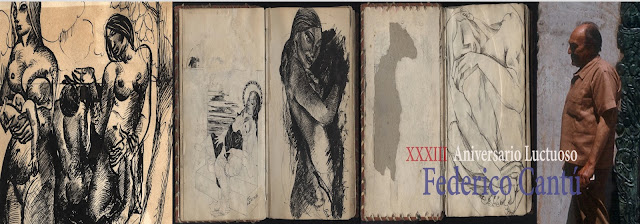
XXXIII Aniversario Luctuoso
Federico Heraclio Cantú Garza
El tríptico de Lord Byron 1928-1929
Colección de Arte Cantú Y de Teresa
Estos tres liensos pintados por Federico Cantú entre los años de 1928 y 1929
Son piezas emblemáticas dentro de la larga carrera pictórica del artista
Si bien su iconografía es de corte sacro y mitológico
Las obras están vinculadas dentro de una historia en común:
La primer retrospectiva que tuviera de Federico Cantú en su paso por Los Ángeles California 1928-1929
Exposición Park 1929 Federico Cantú
En un breve respiro tomado por Federico Cantú dentro de su larga estancia en Paris
en el verano de 1928 por fin el joven artista ve la posibilitada de exponer en Los Ángeles California , esta retrospectiva que anticipaba la muestra del ya consagrado José Clemente Orozco en el mismo lugar, mostraría la visión de un artista mexicano recién llegado de Paris.
Ayudado por la critica de Arthur Miller, Edward Doro y José Vasconcelos el joven pintor daría mucho de que hablar con sus temas universales.
La retrospectiva mostraba un centenar de pinturas dibujos y grabados con temas como “Arlequín”, “Los Novios”, “Escenas de celos” , “Centauros” y El Tríptico de Lord Byron ( Madona, Homenaje s Lord Byron, Descanso en la huida a Egipto )
Bo
ACE Art Consultant & Specialist
En 1930, despues de la Expo en Los Ángeles California, Federico Cantú regresaría a Paris donde trabajaría por cuatro años mas , un ultimo respiro para dejar Paris por siempre , sin duda en el ir y venir , va dejando obra que jamás recuperara , sin embargo
con el tiempo la obsesión de localizar la obra temprana y ayudado por con la ayuda del MacKinley Helm los tres lienzos que decide bautizar en grupo como “El tríptico de Lord Byron” fueron recuperados por el artista tres décadas después de dicha exposición
este 2022 podemos admirar dos de estas obras en dos museos de Nuevo León
Homenaje a Lord Byron , dentro de la expo Tres Pioneros , en Pinacoteca
Y Madona , en el MUNE